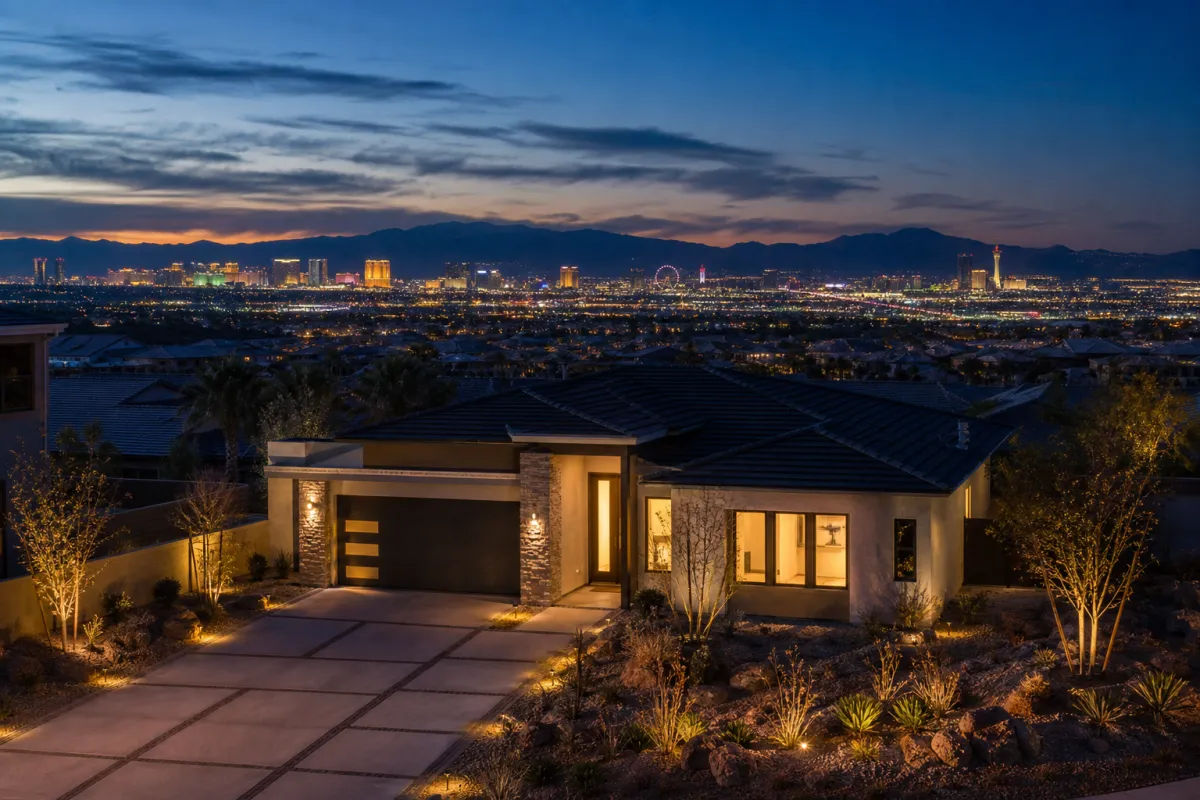
Buy or Build in Las Vegas Valley? 2026 Cost Comparison
¿Prefieres leer este artículo en español? Lee la versión en español aquí.
Quick Answer
If you are deciding whether to buy an existing home, purchase new construction from a builder, or build a custom home in the Las Vegas Valley, the least expensive option is not automatically obvious from the advertised price.
For many buyers:
Resale offers the most predictable total cost and the shortest path to moving in.
Production-builder new construction can offer newer systems, warranties, modern layouts, and valuable incentives, but the final price can increase with lot premiums, structural options, design upgrades, landscaping, window coverings, HOA costs, and financing choices.
Custom construction gives you the most control but also introduces the most variables: land, design, engineering, permits, site work, utilities, construction financing, materials, labor, landscaping, and contingency reserves.
The useful comparison is not list price vs. builder base price.
It is total cost vs. total cost.
Key Takeaways
A resale home's list price usually gives you a clearer starting point, but condition, repairs, remodeling, HOA costs, and financing still matter.
A builder's advertised base price may be only the beginning of the final new-construction cost.
Builder incentives can improve the numbers, but they should be evaluated together with financing terms and the total purchase package.
Development and permitting costs are part of new construction, but buyers should not assume every government fee will appear as a separate buyer-paid charge on a production-builder contract.
A custom build requires budgeting for the lot, design, engineering, permits, site preparation, utilities, construction, financing, and contingencies.
Property taxes should be estimated for the specific property rather than comparing your future bill with the current owner's tax bill.
Timeline matters financially. Carrying two homes, renting during construction, or paying construction-loan interest can change the comparison.
The right answer depends on your budget, timeline, desired location, tolerance for uncertainty, and how much customization you actually want.
What Does “Buy or Build” Really Mean in Las Vegas?
Before comparing costs, it helps to separate three very different options.
Option 1: Buy a resale home
You purchase a home that has already been owned and occupied.
Option 2: Buy new construction from a production builder
You buy from a builder developing a community, whether that means a quick-move-in home, a home already under construction, or a home built after you select a floor plan and lot.
Option 3: Build a custom home
You acquire a lot and assemble the project yourself with architects, engineers, contractors, lenders, government approvals, utilities, and other professionals.
These three paths should not be evaluated using the same assumptions.
A buyer comparing new construction in Henderson with an established resale home has a very different decision from someone purchasing land and commissioning a one-of-a-kind custom residence.
What Does a Resale Home Really Cost?
A resale home is usually the easiest of the three options to evaluate because you are looking at an existing property.
You know the house.
You know the lot.
You can see the surrounding neighborhood.
You can inspect the property's current condition.
But the purchase price is still not the entire cost.
A resale buyer should consider:
Purchase price
Down payment
Mortgage and lender costs
Appraisal
Home inspection
Specialized inspections when appropriate
Title and escrow costs
HOA-related charges
Property taxes
Insurance
Immediate repairs
Remodeling
Appliance replacement
HVAC, roof, pool, or other major systems
Landscaping
Long-term maintenance
A resale home may already include expensive items that buyers sometimes forget to value.
Examples include a finished backyard, mature landscaping, window coverings, ceiling fans, lighting, appliances, pool improvements, patio covers, storage, and other features.
Those items may already be included in the purchase price.
That becomes important when comparing resale with a new home that still needs several of those items after closing.
What Does Production-Builder New Construction Really Cost?
This is where buyers can make one of the biggest comparison mistakes.
They see:
Resale home: $550,000
and then:
New homes starting from $499,990
The builder appears cheaper.
But those numbers may not represent comparable finished homes.
A builder's starting price can change based on:
Floor plan
Elevation
Lot
Lot premium
Structural changes
Bedroom or bathroom configuration
Garage options
Flooring
Cabinets
Countertops
Appliances
Electrical upgrades
Lighting
Plumbing fixtures
Smart-home options
Design-center selections
Landscaping
Window coverings
HOA or master-association costs
Financing choices
That is why my West Henderson new construction guide emphasizes comparing the finished cost of the home you would actually buy, not simply the advertised starting price.
Are Lot Premiums Really That Important?
They can be.
Two homes with the same floor plan can have different prices because of where the lot sits within the development.
A builder may charge more for:
Larger lots
Corner lots
Cul-de-sac locations
View lots
Elevated lots
Lots bordering open space
Lots near parks
Lots with greater separation from neighboring homes
The question is not whether a lot premium is automatically good or bad.
The question is whether the location is worth the additional cost to you.
A $25,000 premium for something you do not value is simply additional cost.
The same premium for a lot characteristic that materially improves your daily enjoyment may be completely different.
How Much Should You Budget for Builder Upgrades?
There is no universal percentage because builders, communities, floor plans, and buyer preferences vary significantly.
Instead of choosing an arbitrary upgrade budget, separate your choices into three groups.
Structural choices
These can be difficult or expensive to change later.
Examples may include room configurations, additional doors, certain electrical changes, plumbing locations, garage options, or other structural modifications.
Finish choices
These may include flooring, countertops, cabinets, fixtures, lighting, backsplash, and appliances.
Items you can potentially add after closing
Depending on the home, this could include window coverings, landscaping, some lighting, storage, certain flooring choices, or other cosmetic improvements.
The goal is not to avoid upgrades.
It is to understand which upgrades make sense to buy from the builder and which ones you may prefer to complete later.
Are Builder Incentives Real Savings?
They can be.
Builders may offer incentives involving:
Closing-cost assistance
Interest-rate incentives
Preferred-lender credits
Upgrade allowances
Design-center credits
Quick-move-in inventory
Other builder-specific promotions
But an incentive should never be evaluated by its headline number alone.
For example, a preferred lender may offer a significant credit.
That can be useful.
But you should still compare:
Interest rate
APR
Points
Lender fees
Closing costs
Rate-lock terms
Cash required at closing
Monthly payment
The better question is:
What does this incentive do to my complete transaction?
Not:
How large is the advertised credit?
Do New-Construction Buyers Pay Development Impact Fees?
Development involves government fees, infrastructure costs, utility-related charges, permits, and other costs that vary depending on the jurisdiction and project.
But production-builder buyers should be careful with how this is described.
A builder or developer may incur many of these costs while developing and constructing the community. Those expenses can ultimately influence home pricing, but they do not necessarily appear as separate buyer-paid line items at closing.
That is different from a custom build, where the property owner or construction project may directly face permitting, utility, site-development, and related costs.
In other words:
Do not assume every government development fee is an additional charge you will personally write a check for when buying a production home.
Review the actual builder contract and pricing sheet.
What Does It Cost to Build a Custom Home in Las Vegas Valley?
A custom build is a different financial category altogether.
The house itself is only one part of the project.
A custom-home budget may include:
Land
Survey
Architectural plans
Structural engineering
Civil engineering
Soils or geotechnical work
Grading
Drainage
Permit and plan-review fees
Utility connections
Water and sewer infrastructure
Site preparation
Retaining walls
Foundation
Vertical construction
Interior finishes
Driveway
Walls or fencing
Landscaping
Pool or outdoor improvements
Construction financing
Insurance
Temporary housing
Contingency reserves
Location can make an enormous difference.
A relatively straightforward flat lot with nearby utilities is a different project from a hillside parcel requiring substantial grading, retaining structures, drainage engineering, or utility extensions.
That is why the price of the dirt alone does not tell you whether a lot is inexpensive.
What Does National Construction-Cost Data Tell Us?
The NAHB Cost of Constructing a Home study reported an average national construction cost of about $428,215, or roughly $162 per square foot of finished floor area, in its 2024 survey.
That number is useful as context.
It is not a Las Vegas custom-home quote.
It should not be multiplied by your desired square footage and treated as your project budget.
A Las Vegas Valley custom build can vary substantially depending on:
Location
Lot conditions
Architecture
Engineering
Quality level
Contractor
Materials
Labor
Site work
Utility access
Landscaping
Pool
Financing
Project complexity
Custom construction should be budgeted from actual local bids and professional estimates.
Which Option Has the Most Predictable Budget?
Generally, the order looks like this:
Option | Cost Predictability | Customization | Timeline Predictability |
|---|---|---|---|
Existing resale home | Higher | Lower | Higher |
Quick-move-in new construction | Relatively high | Lower | Relatively high |
To-be-built production home | Moderate | Moderate | Moderate |
Fully custom home | Lower | Highest | Lower |
This does not mean resale is always cheaper.
It means there are fewer unknowns.
A finished resale home allows you to inspect what already exists.
A custom build requires decisions and cost estimates for components that may not exist yet.
Which Option Usually Lets You Move Faster?
If timing matters, this can be as important as purchase price.
Resale
Once you are under contract, the transaction can proceed through financing, inspections, appraisal, title, escrow, and closing without waiting for the house itself to be constructed.
Quick-move-in new construction
A completed or nearly completed builder home may offer a timeline much closer to resale.
To-be-built production home
You may need to wait through construction, selections, inspections, walkthroughs, and builder scheduling.
Custom home
You may need to complete land due diligence, design, engineering, approvals, permitting, financing, site preparation, and construction before moving in.
The financial cost of time should be part of the comparison.
If you must rent while building, carry another mortgage, store belongings, or pay construction-loan interest, those costs belong in the project budget.
What About Property Taxes on New Construction vs. Resale?
Do not compare properties simply by looking at the current seller's tax bill.
Nevada property-tax calculations and tax-abatement rules can make that misleading.
New construction, ownership changes, owner occupancy, assessed value, exemptions, and the applicable tax district can affect the eventual bill.
The practical approach is to obtain a property-specific tax estimate instead of assuming:
“The current owner pays this amount, so I will too.”
Likewise, do not assume that two homes with the same purchase price will necessarily have identical property-tax histories or bills.
Property taxes should be part of your total-cost comparison, but they should be verified for the actual property.
How Should You Compare New Construction With Resale in Henderson?
This is especially important in Henderson because buyers can often compare new and established homes within relatively close geographic areas.
For example, buyers may consider newer construction in Cadence, Inspirada, Lake Las Vegas, or West Henderson while also looking at established resale inventory elsewhere in Henderson.
Your comparison should include more than price.
Consider:
Finished purchase price
Monthly payment
Interest rate
HOA dues
Master and sub-association dues
Lot size
Landscaping
Window coverings
Appliances
Repairs
Warranty
Expected maintenance
Location
Commute
Parks and amenities
Construction around the home
Timeline
Long-term fit
If you are still learning how builder purchases work, my new-construction buyer-agent guide explains builder representation, incentives, financing, lot premiums, contracts, inspections, and other issues buyers should understand before registering at a sales office.
Should You Contact an Agent Before Visiting a Builder?
If you want your own representation, that conversation should happen before your first builder visit or registration.
Builders establish their own policies regarding outside real estate agents.
Those policies can vary.
Your agent may need to accompany you, register you, or otherwise establish the relationship from the beginning.
The builder's sales representative works for the builder.
Your buyer's agent works under your brokerage relationship and helps you evaluate the transaction from your side.
My home-buying resources are also a useful starting point if you are still preparing your budget, financing, and purchase plan.
Practical Buy-vs.-Build Cost Checklist
Before choosing a resale home, builder home, or custom project, compare the same categories for each option:
Property
Final purchase or project price
Lot
Square footage
Floor plan
Location
Cash needed
Down payment
Deposits
Closing costs
Upgrade deposits
Construction-loan requirements
Contingency reserves
Financing
Interest rate
APR
Lender fees
Builder credits
Rate-buydown terms
Monthly payment
Construction-loan carrying costs
Home completion
Flooring
Appliances
Window coverings
Landscaping
Backyard
Fencing or walls
Lighting
Storage
Pool or outdoor features
Ongoing ownership
HOA
Sub-association
Property taxes
Insurance
Utilities
Maintenance
Warranty coverage
Timing
When can you move in?
Will you need temporary housing?
Will you carry two properties?
How much schedule uncertainty can you tolerate?
Once those categories are compared side by side, the decision usually becomes much clearer.
Alejandro’s Local Take
When buyers ask me whether they should buy resale or new construction, I try to stop the comparison from becoming:
“Which one has the lower advertised price?”
That is usually the wrong question.
I want to compare the resale home as it actually exists with the new home as you would actually finish it.
Does the resale already have the backyard, blinds, upgraded flooring, ceiling fans, appliances, and mature landscaping?
Does the new home require a lot premium, structural upgrades, design-center selections, landscaping, and window coverings?
What financing is available on each one?
What will the monthly payment be?
How quickly do you need to move?
Which location works better?
Then we can make a useful comparison.
A custom build requires another level of analysis because now we are not simply comparing two homes.
We are evaluating an entire construction project.
The right choice is not necessarily the newest property or the lowest advertised price.
It is the option whose complete cost, timeline, location, and lifestyle fit your plan.
Frequently Asked Questions
Is it cheaper to buy resale or new construction in Las Vegas?
Not always one or the other.
A resale home may provide more completed features for the purchase price, while a builder may offer financing incentives, warranties, or a lower-maintenance home that improves the comparison.
Use the finished total cost of each property, not list price vs. base price.
How much above the builder's base price should I expect to pay?
There is no reliable universal percentage.
The difference depends on the builder, lot, floor plan, structural choices, design selections, landscaping, appliances, incentives, and what is included as standard.
Ask for a written breakdown for the specific home you are considering.
Are builder incentives worth it?
They can be.
Compare the incentive with the full financing package, home price, upgrade costs, cash to close, and monthly payment.
An incentive is valuable only if it improves the overall transaction for you.
Do I need a real estate agent for new construction?
You are not required to use your own agent, but buyers who want independent representation should establish that relationship before visiting or registering with a builder.
For a deeper explanation, read my guide to buyer representation for new construction in Henderson.
Is custom building cheaper than buying an existing home?
Custom building should not be assumed to be the cheaper option.
It adds land, design, engineering, permitting, site work, utilities, financing, construction, and contingency expenses that do not exist in the same form when purchasing a finished home.
Custom building usually makes the most sense when customization or location is important enough to justify the additional complexity.
What is the fastest option?
A resale or completed quick-move-in builder home will generally offer the most direct path to occupancy because the structure already exists.
A to-be-built home requires construction time.
A custom project adds design, approvals, site work, and construction before occupancy.
Should I compare builder financing with an outside lender?
Yes.
A preferred builder lender may offer valuable incentives, but compare rate, APR, fees, points, credits, rate-lock terms, monthly payment, and cash required to close.
Should I buy new construction or resale in Henderson?
Both can make sense.
New construction may appeal to buyers who prioritize newer systems, warranties, energy efficiency, modern layouts, and design choices.
Resale may appeal to buyers who prefer established neighborhoods, completed landscaping, shorter timelines, larger lots, or homes where they can see exactly what they are buying.
For a deeper local comparison, my West Henderson new construction guide explains the cost factors buyers should evaluate before making that decision.
Compare the Finished Cost, Not the Starting Price
Buying resale, purchasing a production-builder home, and building custom can all be reasonable choices in the Las Vegas Valley.
But they solve different problems.
Resale offers an existing home you can evaluate now.
Production new construction offers a newer home with different levels of customization and builder-specific terms.
Custom construction gives you the greatest control but requires managing an entire project and a larger number of financial variables.
If you are beginning your comparison, start with my new construction page to explore the questions buyers should consider before visiting builder communities.
For a deeper discussion of builder pricing, lot premiums, upgrades, and incentives, read my West Henderson new construction guide.
And if you want help comparing a specific resale property with a builder home before you make a commitment, contact Alejandro Grimaldo.
About Alejandro
Alejandro Grimaldo is a Nevada real estate agent with United Realty Group, serving Las Vegas, Henderson, and Southern Nevada. He helps buyers compare resale homes, new construction, builder communities, financing considerations, lot choices, upgrades, and long-term ownership factors before making a decision.
Alejandro Grimaldo
United Realty Group
Nevada Real Estate License S.0175370
725-425-1414
Equal Housing Opportunity.
Disclaimer
This article provides general real estate information only and is not legal, tax, accounting, engineering, construction, lending, inspection, investment, or financial advice. Builder pricing, incentives, lot premiums, upgrade costs, construction costs, government fees, HOA charges, financing terms, property taxes, timelines, permits, and availability can change and vary by property and project. Buyers considering new or custom construction should verify all costs, contract terms, tax estimates, permits, engineering requirements, construction bids, financing, and HOA information with the appropriate builder, contractor, architect, engineer, lender, tax professional, government agency, attorney, inspector, escrow officer, or other qualified professional before making a decision.
