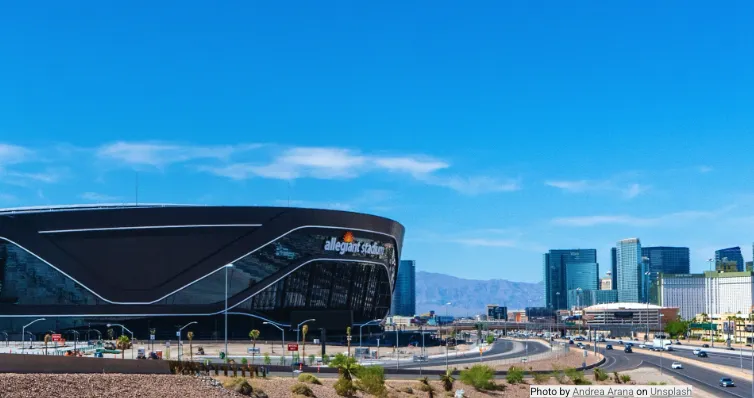
Allegiant Stadium’s Real Estate Impact in Las Vegas
¿Prefieres leer este artículo en español? Lee la versión en español aquí.
Quick Answer
Allegiant Stadium has helped reshape the south Strip corridor by increasing attention on nearby commercial parcels, infill development, entertainment-adjacent properties, and buyer interest in locations with convenient access to major sports and concert events. For residential buyers and sellers, the stadium is best understood as a lifestyle and location factor, not a guaranteed home-price premium.
The clearest real estate impact is closest to the stadium, particularly in commercial, hospitality, multifamily, parking, and redevelopment opportunities near Russell Road, Hacienda Avenue, Polaris Avenue, I-15, and the resort corridor. For traditional homeowners, the stadium can help tell a stronger lifestyle story, but pricing still depends on comparable sales, property condition, location, financing conditions, and overall Las Vegas market trends.
Key Takeaways
Allegiant Stadium has strengthened the identity of Las Vegas as a major sports and entertainment city.
The strongest real estate impact is near the stadium corridor, especially for commercial, hospitality, multifamily, and redevelopment properties.
Many factors influence residential property values, so it is not accurate to say the stadium alone caused broad Las Vegas home-price growth.
Buyers should consider event-day traffic, parking patterns, noise, freeway access, and everyday livability before choosing a home near the stadium.
Sellers near the stadium can use proximity as part of the lifestyle story, but pricing and presentation still matter most.
Investors must verify zoning, short-term rental rules, licensing, spacing requirements, and Clark County regulations before assuming stadium-related income.
For long-term real estate decisions, the stadium is one important factor within the larger Las Vegas housing market.
Why Allegiant Stadium Matters to Las Vegas Real Estate
Allegiant Stadium is more than a football venue. It has become one of the major anchors of Las Vegas’ sports and entertainment identity. The stadium hosts Raiders football, UNLV football, concerts, soccer matches, special events, and national sports events that bring thousands of visitors into the south Strip area.
That matters for real estate because major venues can change how people think about location. Buyers may value quick access to games and concerts. Sellers may market proximity as a lifestyle benefit. Investors may look at nearby land, older commercial properties, small motels, parking lots, and redevelopment sites differently once a major venue begins attracting consistent activity.
For buyers comparing lifestyle, commute, and entertainment access, Allegiant Stadium is one piece of the larger Las Vegas real estate decision.
What the Data Can and Cannot Prove
Here is the honest answer: there is no simple, reliable number that proves Allegiant Stadium raised surrounding home values by a specific percentage across the Las Vegas Valley.
That kind of claim would be too broad. Home values are affected by supply, demand, interest rates, population growth, job growth, property condition, neighborhood quality, financing, comparable sales, and overall market timing. The AIM draft correctly recognized that direct stadium-specific price-effect data for the broader Las Vegas Valley is limited.
The better way to look at it is this:
Allegiant Stadium has likely had its strongest effect on the perception, use, and redevelopment potential of nearby land and properties. That is different from saying every nearby house automatically became more valuable because of the stadium.
For residential buyers and sellers, the stadium is best treated as a location and lifestyle amenity. For investors and developers, it may be part of a larger commercial and redevelopment thesis.
Allegiant Stadium: Key Facts at a Glance
Allegiant Stadium Key Facts
Venue: Allegiant Stadium
Location: Russell Road and Polaris Avenue, west of I-15, near the south Strip
Jurisdiction: Paradise / unincorporated Clark County
Seating capacity: Approximately 65,000
Primary NFL tenant: Las Vegas Raiders
Super Bowl history: Hosted Super Bowl LVIII on February 11, 2024
Real estate relevance: Commercial redevelopment, stadium access, event traffic, hospitality, parking, and lifestyle demand.
Allegiant Stadium hosted Super Bowl LVIII in Las Vegas on February 11, 2024, which reinforced Las Vegas’ position as a major event destination. The NFL regular season now has 17 games, and teams alternate between seasons with either nine regular-season home games and one preseason home game or eight regular-season home games and two preseason home games.
So instead of saying the Raiders have “10 regular-season home games,” the safer wording is: the Raiders typically host eight or nine regular-season home games, plus preseason games, while the stadium calendar extends well beyond football.
How the Stadium Affects Nearby Development
The stadium’s immediate surroundings are not traditional residential neighborhoods. Much of the nearby area includes resort corridor properties, commercial parcels, industrial uses, parking areas, hotels, and land positioned for future redevelopment.
That is why the real estate impact is strongest in areas like:
Commercial redevelopment
Multifamily and mixed-use potential
Hotel and hospitality-adjacent uses
Entertainment-oriented retail
Parking and transportation-related parcels
Older commercial properties that may be repositioned over time
The stadium sits within unincorporated Clark County, not the City of Las Vegas. That matters because zoning, land use, short-term rental licensing, and many redevelopment approvals are handled through Clark County processes. Buyers and investors should not assume City of Las Vegas rules apply simply because the mailing address says “Las Vegas.”
If you are considering a property near the stadium corridor for investment, zoning and licensing matter as much as location.
Residential Areas Buyers May Compare
The stadium does not sit in the middle of a typical subdivision, so most residential buyers compare areas a little farther away. The goal is usually to balance stadium access with everyday livability.
Strip-area high-rise condos
Some buyers want quick access to Allegiant Stadium, T-Mobile Arena, restaurants, entertainment, and the resort corridor. For those buyers, Strip-area or Strip-adjacent condos may be appealing, especially if parking, building amenities, and views are important.
This buyer profile may include second-home owners, sports fans, executives, entertainers, or people who want a more urban Las Vegas lifestyle.
Spring Valley and southwest Las Vegas
Spring Valley and southwest Las Vegas can appeal to buyers who want a more residential feel while staying within a reasonable drive of Allegiant Stadium, the Strip, the airport, and major employment corridors.
The tradeoff is event-day congestion. A drive that feels easy on a normal weekday may be very different before or after a Raiders game, major concert, or special event.
Buyers who want stadium access but prefer a more residential setting may also compare Las Vegas communities, southwest valley neighborhoods, and nearby Henderson communities before deciding where to focus.
Henderson buyers
Henderson is not next door to Allegiant Stadium, but some buyers prefer Henderson because of its suburban feel, master-planned communities, schools, parks, 55+ options, newer construction areas, and overall lifestyle.
For many buyers, Henderson provides access to stadium events when desired without living directly in the event corridor. That balance can be attractive for families, relocating buyers, retirees, and buyers who want a quieter day-to-day environment.
If you are comparing entertainment access with lifestyle, schools, parks, 55+ communities, and newer home options, review my Henderson Communities Guide and New Construction Homes resources.
Game-Day Traffic: The Factor Buyers Should Not Ignore
A home that feels 15 minutes from Allegiant Stadium on a Tuesday may feel very different on a Raiders Sunday or major concert night.
Event-day traffic can affect:
I-15 access
Russell Road
Hacienda Avenue
Polaris Avenue
Rideshare pickup and drop-off areas
Parking lots
Pedestrian routes from the Strip
Nearby commercial streets
The issue is not only the stadium itself. It is the movement of thousands of people before and after an event.
Before buying close to the stadium, buyers should check real event-day conditions. Drive the area during a major event. Look at where traffic backs up. Check whether certain streets close or become restricted. Review how parking and rideshare areas affect the neighborhood.
The right location for one buyer may be the wrong location for another. A sports fan may love being close. A buyer who values quiet weekends may not.
Short-Term Rentals Near Allegiant Stadium: The Regulatory Reality
Many investors ask whether a property near Allegiant Stadium could work as a short-term rental.
The answer is: maybe, but only after careful verification.
Clark County’s short-term rental rules are important because Allegiant Stadium is in unincorporated Clark County. Clark County explains that Nevada AB 363 required local governments to establish short-term rental regulations, and Clark County adopted an ordinance in June 2022 to create a regulated licensing process for unincorporated residential areas.
That means investors should not assume they can simply buy a property near the stadium and rent it nightly for game weekends. Licensing, spacing rules, ownership limitations, inspections, HOA restrictions, zoning, and eligibility can all affect whether a property works as a legal short-term rental.
Before buying with stadium-event rental income in mind, verify:
Whether the property is in unincorporated Clark County or a city jurisdiction
Whether short-term rentals are allowed in that location
Whether the property is eligible for licensing
Whether HOA rules prohibit or restrict rentals
Whether spacing requirements affect eligibility
Whether occupancy, parking, safety, and inspection rules can be met
Whether the numbers still work if the property cannot be used as an STR
If you are buying primarily for investment income, this is not a detail to check after closing. It needs to be part of your due diligence before you make an offer.
Before Buying Near Allegiant Stadium: Practical Checklist
Before buying a home, condo, or investment property near Allegiant Stadium, review the following:
How does the area feel on non-event days?
How does traffic change during Raiders games, concerts, and major events?
Are nearby streets subject to event closures or restrictions?
Is parking convenient, limited, or disruptive?
Is the property in unincorporated Clark County or within a city jurisdiction?
Are short-term rentals allowed, restricted, or prohibited?
Does the HOA allow rentals?
Are there nearby redevelopment projects that could change the area?
Is the property priced based on real comparable sales or stadium hype?
Would the location still work for you if there were no stadium nearby?
That last question is important. A stadium can add lifestyle appeal, but it should not be the only reason to buy.
Alejandro’s Local Take
For most residential buyers, I would not recommend choosing a home only because it is close to Allegiant Stadium. The better question is whether the location gives you the lifestyle you want without creating daily inconvenience.
For some buyers, being close to Raiders games, concerts, the Strip, and major events is a real benefit. For others, the event traffic, parking activity, and noise may outweigh the convenience.
My advice is to compare the stadium lifestyle against your normal weekly routine. Where do you work? Where do you shop? How often would you attend events? Do you want energy and access, or do you want quiet and separation?
That is where a local real estate conversation matters. The “best” area depends on how you actually plan to live.
What This Means for Buyers
For buyers, Allegiant Stadium adds another lifestyle factor to consider when choosing where to live in Las Vegas.
If you love sports, concerts, nightlife, and quick access to the Strip corridor, being closer to the stadium may be appealing. If you prefer quiet neighborhoods, less congestion, larger lots, or suburban master-planned communities, you may prefer areas farther away.
If you are still deciding where to buy, start with my buyer resources and compare the stadium area with other Las Vegas and Henderson options.
The most important thing is not simply distance. The most important thing is fit.
What This Means for Sellers
For sellers, proximity to Allegiant Stadium can be part of your property’s lifestyle story.
That does not mean you should overprice your home. Buyers still compare condition, upgrades, floor plan, location, financing costs, and comparable sales. However, if your property offers convenient access to the stadium, the Strip, the airport, or major employment corridors, that should be presented clearly in your marketing.
For sellers near Spring Valley, southwest Las Vegas, Strip-adjacent condos, or central Las Vegas corridors, the stadium may help attract buyers who value entertainment access.
For pricing, the stadium should support the story, not replace the data. If you are preparing to sell, review my guide on pricing your home right or request a home value review.
What This Means for Investors
For investors, Allegiant Stadium creates opportunity, but not automatic profit.
The strongest opportunities may involve commercial land, redevelopment, multifamily potential, hotel-adjacent properties, parking, and properties that benefit from event-driven demand. However, those opportunities require more due diligence than a normal residential purchase.
Investors should review:
Zoning
Entitlements
Clark County jurisdiction
STR licensing eligibility
HOA rules
Parking demand
Event-day access
Long-term redevelopment plans
Comparable rents and resale data
Financing and operating costs
The stadium may create demand, but the property still has to pencil out.
Frequently Asked Questions
Is buying a home near Allegiant Stadium a good long-term investment?
It can be, but it depends on the property type, price, location, traffic patterns, and your long-term goal. The stadium may support lifestyle demand and investor interest, but there is no guaranteed stadium premium for every nearby home.
Has Allegiant Stadium increased Las Vegas home values?
Allegiant Stadium has likely influenced nearby redevelopment interest and the way buyers think about stadium access. However, broad Las Vegas home values are affected by many factors, including supply, demand, interest rates, population growth, property condition, and comparable sales. It is better to view the stadium as one location factor, not the only cause of price changes.
Are short-term rentals allowed near Allegiant Stadium?
Some may be allowed, but the rules depend on jurisdiction, licensing, property eligibility, spacing requirements, HOA rules, and Clark County regulations. Clark County has a regulated short-term rental licensing process for unincorporated areas, so investors should verify eligibility before buying.
What neighborhoods are close to Allegiant Stadium?
The closest areas include the south Strip corridor, Paradise, parts of Spring Valley, and southwest Las Vegas. Many buyers also compare nearby residential areas with Henderson or other Las Vegas communities depending on commute, lifestyle, schools, and neighborhood feel.
Should sellers mention Allegiant Stadium in their marketing?
Yes, when it is relevant. Stadium access can be a useful lifestyle feature, especially for buyers who value sports, concerts, the Strip, airport access, or event convenience. However, sellers should not rely on stadium proximity alone. Accurate pricing, presentation, and comparable sales remain more important.
Should I buy near the stadium if I do not attend games or concerts?
Maybe, but you should be honest about the tradeoffs. If you do not use the stadium or entertainment corridor often, event traffic and congestion may feel like a burden instead of a benefit. In that case, other Las Vegas or Henderson neighborhoods may be a better fit.
The Bottom Line
Allegiant Stadium has changed the way buyers, sellers, investors, and developers think about the south Strip corridor and surrounding areas. Its biggest real estate impact is not a simple home-price formula. Its impact comes from lifestyle demand, redevelopment interest, event traffic, commercial opportunity, and Las Vegas’ growing identity as a major sports and entertainment city.
For buyers, the key is lifestyle fit. For sellers, the key is presenting stadium access honestly as part of the property story. For investors, the key is due diligence.
If you are comparing homes, neighborhoods, or investment opportunities near Allegiant Stadium, Spring Valley, southwest Las Vegas, Henderson, or the broader Las Vegas Valley, I can help you evaluate the tradeoffs clearly.
Call or text Alejandro Grimaldo at 725-425-1414 or visit alejandrogrimaldo.com/contact to schedule a consultation.
About Alejandro Grimaldo
Alejandro Grimaldo is a Nevada real estate agent with United Realty Group serving Las Vegas, Henderson, and Southern Nevada. He helps buyers, sellers, relocating families, 55+ clients, new construction buyers, and homeowners compare communities, property values, lifestyle tradeoffs, and resale options with clear local guidance at alejandrogrimaldo.com.
United Realty Group · 725-425-1414
Equal Housing Opportunity. Alejandro Grimaldo, Salesperson_S.0175370, licensed in Nevada and regulated by the Nevada Real Estate Division.
This article is for general real estate information only and is not legal, tax, lending, investment, or financial advice. Confirm all figures, zoning details, short-term rental rules, transaction costs, and investment assumptions with the appropriate licensed professionals or government agencies before making a decision.